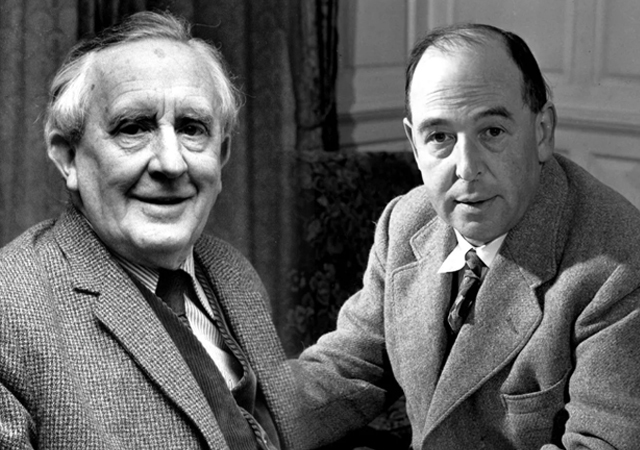
J.R.R. Tolkien and C.S. Lewis shared a close friendship, mutual respect, and a love for storytelling. Both were members of the Inklings, a literary group that frequently met to discuss literature and share their works in progress. Despite their camaraderie, there were significant differences in their literary styles and theological approaches, which sometimes led to divergent opinions. Tolkien was of course a devout Catholic and Lewis was…well, not a Catholic. (Lewis’s theology was problematic in other ways) I digress.
One of the most notable disagreements between them was Tolkien’s distaste for Lewis’s The Screwtape Letters. Although Tolkien admired Lewis as a writer and thinker, he held reservations about this particular work. For anyone unfamiliar with The Screwtape Letters, the book is a satirical novel in the form of letters from a senior demon, Screwtape, to his nephew, Wormwood, a junior tempter. Screwtape advises Wormwood on ways to corrupt a human’s soul, revealing insights into human nature, temptation, and the subtle tactics of spiritual warfare.
Tolkien’s primary concern with The Screwtape Letters stemmed from its narrative style and theological approach. Tolkien felt that adopting a demonic viewpoint was risky and potentially dangerous. He believed that Lewis’s portrayal of demonic characters and their twisted reasoning could inadvertently lead readers to misunderstand the nature of evil. For Tolkien, spending too much time articulating the thoughts of demons, even for the sake of satire, was spiritually and morally problematic.
Additionally, Tolkien had a different view of how to portray good and evil in literature. While Lewis was comfortable with a more direct, allegorical style—using personifications of virtues and vices to depict spiritual realities— (Aslan the Lion as Christ for example) Tolkien preferred a more subtle and mythopoeic approach. In his own works, such as The Lord of the Rings, Tolkien illustrated the struggle between good and evil through complex characters, mythical landscapes, and rich narratives that hinted at deeper truths without resorting to overt theological statements. He believed that good and evil should be shown through actions and choices rather than explained explicitly. The directness of The Screwtape Letters, where the inner workings of evil are openly described, clashed with Tolkien’s aesthetic and theological sensibilities.
Moreover, Tolkien was concerned that Lewis’s attempt to get into the mind of a demon might negatively affect the author himself. According to Humphrey Carpenter’s biography J.R.R. Tolkien, Tolkien reportedly told others that writing from a demonic perspective could put Lewis’s mind “in danger.” Tolkien’s theology, with its emphasis on the mystery of evil and the dangers of demonic influence, likely contributed to this cautionary stance. He felt that attempting to imagine and articulate the mindset of a demon was not only risky for the writer but also for the reader.
Ultimately, Tolkien’s criticism of The Screwtape Letters reflects the broader differences between the two authors’ views on the role of fiction in exploring spiritual truths. While Lewis sought to illuminate Christian doctrine through straightforward allegory and satire, Tolkien preferred a more indirect and mythological approach. Despite these disagreements, the two maintained a deep respect for each other’s works and contributions to literature and theology. Their friendship endured, even if Tolkien never fully warmed up to The Screwtape Letters. As a matter of fact when the time came to publish Screwtape who did Lewis decide to dedicate the book to?
JRR Tolkien.



 Develop to Deploy
Leave a comment